
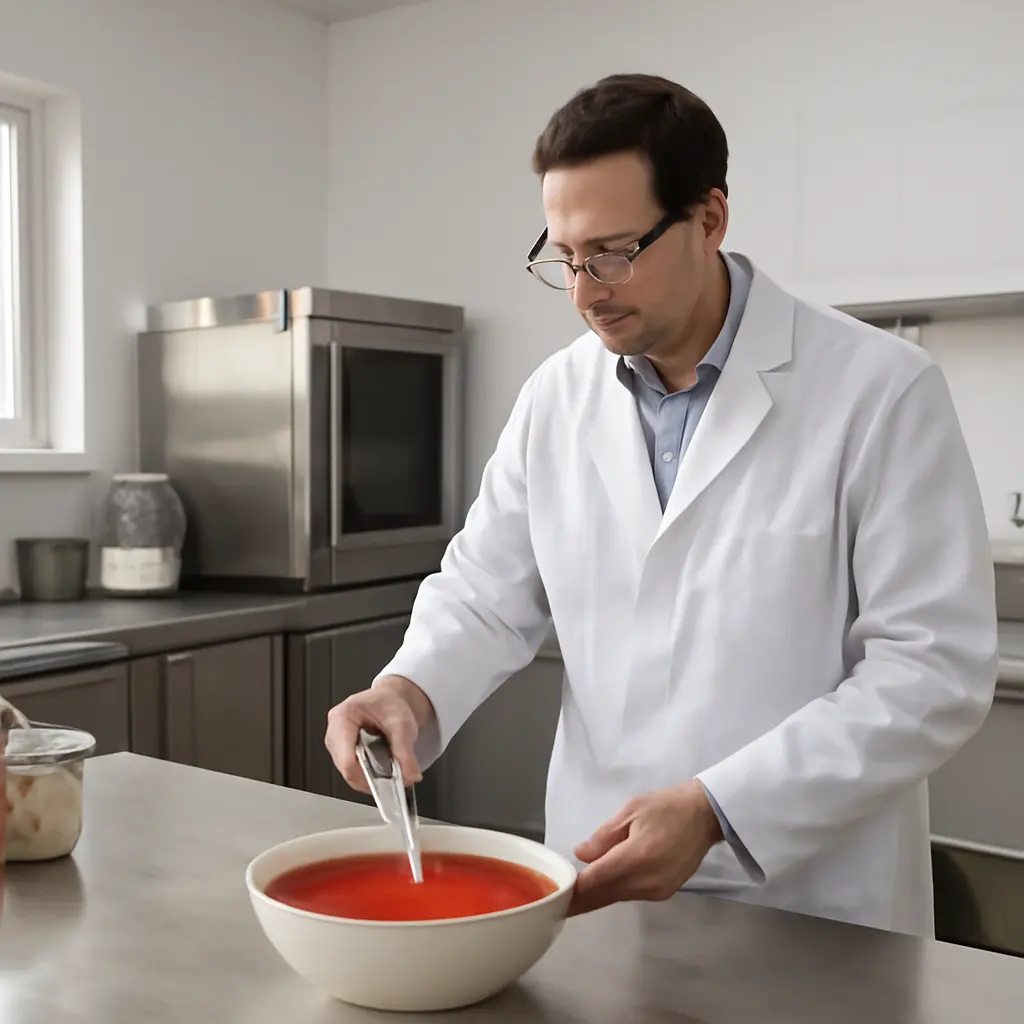
Organic sauces are foods made with ingredients certified under applicable organic standards, but “organic” does not mean sterile, preservative-free, or shelf-stable. Food scientists preserve these sauces by controlling acidity, water activity, heat treatment, packaging, and storage as a coordinated system. That matters because the U.S. Centers for Disease Control and Prevention estimates that foodborne illness causes about 48 million illnesses, 128,000 hospitalizations, and 3,000 deaths in the United States each year. The practical lesson is that a recipe’s appearance, taste, or “natural” ingredients cannot establish safety: validated measurements and a process suited to the specific sauce are essential.
Food scientists define organic sauce preservation as a validated safety-and-quality system
Organic sauce preservation is the use of controlled formulation, processing, packaging, and storage conditions to slow spoilage and prevent harmful microorganisms from growing or surviving. The U.S. Department of Agriculture’s National Organic Program governs how products may be represented and which production and handling practices qualify for organic certification; it does not certify that a food is pathogen-free or automatically shelf-stable. Food safety still depends on the product’s measurable properties and the effectiveness of its processing.
The central distinction is between quality preservation and safety preservation. Refrigeration, oxygen control, and suitable packaging can help retain color and flavor, while acidification or a validated heat process may be necessary to control pathogens. Sauces differ widely: a vinegar-forward dressing, a chunky tomato salsa, and a creamy refrigerated sauce do not share one safe processing recipe. Their acidity, texture, ingredients, container, and intended storage all affect the appropriate controls.
Organic certification governs production claims, not preservation performance
Under USDA organic rules, certification concerns agricultural production, ingredient eligibility, handling, and labeling. It does not replace hazard analysis or establish a universal method for canning, bottling, or preserving sauces. A certified organic ingredient can still carry microorganisms, and an organic finished product can still become unsafe if it is formulated or processed incorrectly.
This distinction is useful when evaluating “clean label” claims. Organic, natural, and preservative-free describe different attributes; none alone demonstrates that a sauce is safe at room temperature. The relevant evidence is a process supported by product-specific measurements and, where required, review by qualified process authorities.
The product’s intended storage determines its preservation strategy
Shelf-stable sauces are formulated and processed so they can be stored unopened without refrigeration under specified conditions. Refrigerated sauces rely on cold storage to limit microbial growth, while frozen sauces use low temperatures to preserve the product for longer periods. These are distinct product categories, not interchangeable labels: a sauce that tastes acidic or contains oil is not necessarily safe to store unrefrigerated.
For U.S. commercial products, acidified foods are generally defined in federal regulations as foods with a finished equilibrium pH of 4.6 or below and water activity above 0.85. The exact regulatory category and required process depend on the food and manufacturing method. That threshold is a classification and safety benchmark, not a home-preservation shortcut or a guarantee that every recipe below it has been properly processed.
Food scientists use acidity, water activity, and heat as complementary controls
Food scientists describe preservation as a set of “hurdles”: conditions that independently or jointly make microbial growth or survival less likely. For sauces, key hurdles include acidity, reduced water activity, heat, refrigeration, and protective packaging. The International Commission on Microbiological Specifications for Foods has advanced this hurdle concept to explain how multiple controls can work together, but each combination must be validated for its actual food.
A useful way to visualize the approach is a simple hurdle chart: acidity, heat, water activity, and cold storage each contribute a separate barrier, while the finished product’s safety depends on the combined, tested system. Adding one control does not automatically compensate for a weak or unverified one.
Equilibrium pH measures acidity throughout the sauce
pH measures how acidic or alkaline a food is on a logarithmic scale. In a sauce, scientists distinguish the pH of the liquid from the equilibrium pH reached after acids distribute through all ingredients, including chunks of vegetables or fruit. For acidified foods, the U.S. Food and Drug Administration’s regulations use an equilibrium pH of 4.6 or below as a defining limit; manufacturers must also establish and follow a process appropriate to the product.
The practical implication is that a quick reading of vinegar or sauce liquid may not represent the interior of solid pieces. Product formulation, particle size, mixing, acid distribution, and time to equilibrate can affect the result. Commercial producers use calibrated instruments and documented procedures; sensory cues such as sourness are not reliable substitutes for measurement.
Water activity describes available moisture, not total water
Water activity, written as aw, measures how available water is for microbial growth rather than how much water a food contains. The FDA’s technical guidance explains that water activity is expressed from 0 to 1; many fresh foods have high values, while drying, salt, or sugar can lower availability. Most bacteria need relatively high water activity to grow, although tolerances vary by organism and food.
Thickening a sauce does not necessarily make it microbiologically stable. Starch, puréed vegetables, or oil can change texture without reducing water activity enough to control hazards. Scientists measure water activity with suitable instruments and consider it alongside pH, ingredients, and processing rather than inferring safety from thickness or sweetness.
Thermal processing must match the sauce and its container
Thermal processing uses a controlled time-and-temperature treatment to reduce microorganisms. The required treatment depends on factors such as acidity, viscosity, particle size, container dimensions, and how heat moves through the product. A thin, acidic sauce heats differently from a thick sauce with large vegetable pieces, so copying a time from another recipe may produce an inadequate process.
Commercial processors establish scheduled processes for their products and equipment, often with a qualified process authority. In the United States, facilities producing acidified or low-acid canned foods may have applicable FDA registration, process filing, and operating requirements. For home canning, the National Center for Home Food Preservation recommends following tested recipes and instructions rather than improvising ingredient proportions, jar size, or processing time.
Food scientists match preservation methods to sauce type and packaging
Once a sauce’s hazards and formulation are understood, scientists choose a compatible preservation pathway. Acidified tomato products, refrigerated herb sauces, and oil-based condiments present different technical challenges. Ingredient substitutions can change acidity, moisture, viscosity, and heat transfer, which is why a method validated for one sauce should not be assumed to work for another.
Acidified sauces need controlled formulation and verification
Acidified sauces include products whose acidity is established or adjusted with ingredients such as vinegar or permitted food acids. The finished equilibrium pH, formulation consistency, and thermal process all matter. Organic status does not alter the need to control these factors, and the allowable ingredients and labeling claims must also comply with relevant organic and food regulations.
A common failure is treating a familiar ingredient as proof of safety: tomatoes, citrus, or vinegar do not guarantee that every finished recipe reaches a safe and consistent acidity. The food’s buffering capacity, ingredient ratios, and solid components affect the final measurement. For commercial production, formulation changes should trigger a technical review rather than an informal taste test.
Refrigerated sauces depend on an uninterrupted cold chain
Refrigerated sauces may use fresh herbs, vegetables, dairy, or other ingredients whose flavor and texture are damaged by intense heat. Cold storage slows microbial growth but does not sterilize food or stop all organisms. The FDA advises keeping refrigerators at 40°F (4°C) or below, and the USDA recommends refrigerating perishable foods within two hours, or within one hour when the surrounding temperature is above 90°F (32°C).
A refrigerated product therefore needs a defined shelf life, suitable packaging, and clear handling instructions. Temperature abuse during shipping, retail display, or home use can undermine the intended control. Consumers should follow the package’s refrigeration directions and discard products that have been stored improperly or show signs of spoilage; appearance alone cannot rule out pathogens.
Oil-based sauces require particular attention to low-acid ingredients
Oil can limit oxygen exposure, but it does not make a sauce safe. Garlic, herbs, and vegetables may introduce low-acid, moist ingredients into an oxygen-limited environment. The National Center for Home Food Preservation warns that improperly prepared garlic-in-oil mixtures can pose a botulism risk and advises refrigeration for short-term storage or freezing for longer storage, using tested guidance.
This example illustrates why “natural” ingredients and oil coverage are not preservation controls by themselves. A commercial oil-based sauce needs a validated formulation and process, while home cooks should not improvise shelf-stable garlic or herb oils.
Packaging protects quality but cannot rescue an unsafe process
Packaging choices affect oxygen exposure, light, contamination after processing, and the product’s ability to maintain a seal. Glass, flexible pouches, and plastic bottles each have different heat-transfer and barrier properties. A package must be compatible with the scheduled process and intended storage conditions; a tight seal alone is not evidence of safety.
For quality, oxygen and light can contribute to flavor changes, pigment loss, and oxidation, especially in sauces containing oils or delicate herbs. Food scientists may select opaque containers, oxygen barriers, or headspace controls, then verify shelf life through appropriate testing. Those measures complement—not replace—microbial controls.
Food scientists validate safety and shelf life instead of relying on labels or appearance
Validation asks whether a defined process reliably achieves its safety objective under specified conditions. Verification checks whether the process is being carried out as intended. In practice, this can involve calibrated pH and water-activity measurements, heat-process records, seal checks, ingredient controls, and microbiological studies designed for the product and its risks.
Shelf-life studies measure both safety and quality
Shelf life is the period during which a product remains acceptable and meets its safety and quality specifications when stored as directed. Scientists assess changes such as microbial growth, pH drift, color, aroma, texture, separation, and package integrity. A product can lose quality before it becomes unsafe, or present a safety risk without obvious changes, so visual inspection alone is inadequate.
A robust study uses the actual recipe, manufacturing process, package, and expected storage conditions. If ingredients, suppliers, particle sizes, equipment, or package formats change, results may no longer apply. This is particularly important for organic sauces because seasonal produce and supplier variation can affect solids, acidity, and moisture.
Real-world process changes require technical review
Consider a small producer replacing fresh tomatoes with a thicker purée or adding more roasted vegetables to an organic salsa. The recipe may taste similar, but the change can alter equilibrium pH, particle distribution, viscosity, and heat penetration. A food scientist would assess whether the existing scheduled process remains valid, take appropriate measurements, and seek process-authority review when necessary before making a shelf-stable product.
The same reasoning applies at home: changing the amount of acid, vegetables, or thickener in a tested canning recipe can change the safety basis. The safest course is to use tested preservation instructions as written and refrigerate or freeze untested sauces rather than attempting to make them shelf-stable.
Conclusion: organic sauce preservation depends on evidence, not assumptions
Food scientists know that organic certification and preservation are separate questions. Safe sauce production depends on matching controls to the product: equilibrium pH for acidified sauces, water activity where relevant, a validated heat treatment, suitable packaging, and reliable refrigeration or freezing. Measurements and process validation matter because recipes, textures, ingredients, and containers change how hazards behave.
For consumers, follow storage directions and use tested home-preservation guidance. For producers, document formulation and process controls, assess changes before implementation, and consult qualified food-safety professionals or process authorities when developing shelf-stable products. Further reading from the FDA, USDA National Organic Program, National Center for Home Food Preservation, and CDC can help clarify the rules and practices that apply to specific products.
Sources: U.S. Centers for Disease Control and Prevention, Estimates of Foodborne Illness in the United States, https://www.cdc.gov/foodborneburden/estimates-overview.html; U.S. Department of Agriculture, National Organic Program, https://www.ams.usda.gov/about-ams/programs-offices/national-organic-program; Electronic Code of Federal Regulations, 21 CFR Part 114—Acidified Foods, https://www.ecfr.gov/current/title-21/chapter-I/subchapter-B/part-114; U.S. Food and Drug Administration, Water Activity (aw) in Foods, https://www.fda.gov/inspections-compliance-enforcement-and-criminal-investigations/inspection-technical-guides/water-activity-aw-foods; National Center for Home Food Preservation, Selecting, Preparing and Canning Tomatoes and Tomato Products, https://nchfp.uga.edu/how/can/how-do-i-can-tomatoes/; National Center for Home Food Preservation, Garlic-in-Oil, https://nchfp.uga.edu/how/ferment/recipes/garlic-in-oil/; U.S. Food and Drug Administration, Refrigerator Thermometers: Cold Facts about Food Safety, https://www.fda.gov/consumers/consumer-updates/refrigerator-thermometers-cold-facts-about-food-safety; U.S. Department of Agriculture, Leftovers and Food Safety, https://www.fsis.usda.gov/food-safety/safe-food-handling-and-preparation/food-safety-basics/leftovers-and-food-safety; International Commission on Microbiological Specifications for Foods, Microorganisms in Foods 6: Microbial Ecology of Food Commodities, Springer.


